

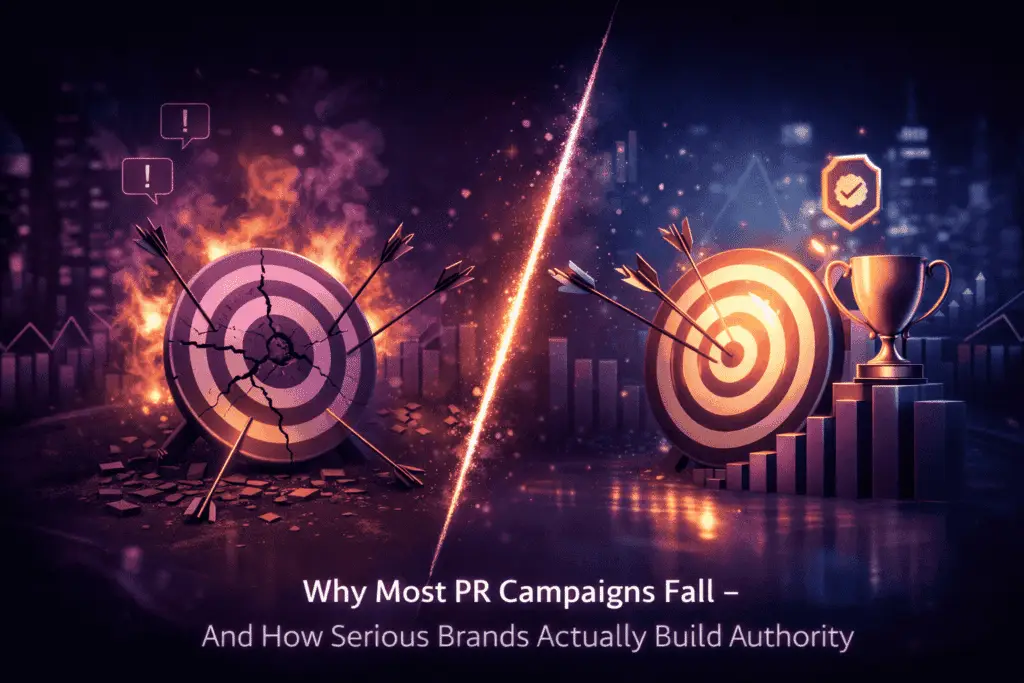
Public Relations is often sold as a shortcut to visibility.
In reality, that misunderstanding is exactly why most PR campaigns fail.
Brands invest money, distribute press releases, get a few links or mentions and then wonder why nothing changes. No authority. No trust. No measurable business impact.
The problem isn’t PR itself.
The problem is how PR is approached.
This article explains:
- Why most PR campaigns fail
- The mistakes brands unknowingly repeat
- How serious brands use PR to build long-term authority
The Biggest Lie About PR
The most common belief in the market is simple:
“If we get media coverage, our brand will grow.”
That belief is wrong.
Media coverage without strategy, relevance, and consistency does very little. It might look impressive for a moment, but it doesn’t build authority.
PR is not about being seen once.
It’s about being recognized repeatedly in the right context.
Why Most PR Campaigns Fail
Let’s be direct. PR campaigns fail for predictable reasons.
1. PR Is Treated Like a One-Time Activity
Many brands treat PR as an event:
- One press release
- One campaign
- One distribution cycle
Authority doesn’t work that way.
Search engines, journalists, investors, and audiences respond to patterns, not one-off appearances.
2. Distribution Is Confused With Placement
Sending a press release to hundreds of websites is not strategy.
Most campaigns focus on:
- Number of links
- Quantity of logos
- Speed of publication
They ignore:
- Editorial relevance
- Contextual credibility
- Audience alignment
Serious brands don’t ask “How many sites?”
They ask “Which platforms actually matter?”
3. No Clear Authority Narrative
Many PR campaigns have no real story.
They rely on:
- Generic announcements
- Vague achievements
- Surface-level updates
Without a clear narrative, coverage becomes forgettable.
Authority is built when messaging reinforces a consistent identity.
4. PR Is Detached From Business Goals
PR is often executed in isolation.
It isn’t connected to:
- Founder credibility
- Sales trust
- Investor visibility
- Search authority
When PR is disconnected from business goals, it becomes decoration—not infrastructure.
5. Short-Term Thinking Destroys Long-Term Trust
Some campaigns chase fast exposure:
- Temporary buzz
- Paid placements with no editorial value
- Irrelevant publications
This creates noise, not trust.
Authority compounds over time.
Short-term PR thinking prevents that compounding.
How Serious Brands Actually Build Authority
Successful brands don’t “run PR campaigns.”
They build PR systems.
1. Authority Comes Before Visibility
Serious brands define:
- What they want to be known for
- In which industry
- Among which decision-makers
Visibility follows positioning—not the other way around.
2. Editorial Relevance Matters More Than Volume
Authority is contextual.
One relevant mention in the right publication outweighs ten irrelevant ones.
Serious brands focus on:
- Industry alignment
- Editorial credibility
- Audience relevance
3. Consistency Beats One-Time Coverage
Authority is built through:
- Repeated mentions
- Aligned narratives
- Long-term presence
Both humans and search engines reward consistency.
4. PR Strengthens Digital Trust
Modern PR supports:
- Brand search trust
- Entity recognition
- Online credibility
- Long-term discoverability
PR shapes how a brand is understood, not just how often it is seen.
5. Long-Term Thinking Wins
Authority is slow.
That’s why it works.
Serious brands invest in PR before they desperately need it.
The Real Purpose of PR
PR is not about:
- Instant fame
- Vanity mentions
- Short-term buzz
PR is about:
- Credibility before scale
- Trust before transactions
- Authority before attention
When done right, PR becomes a strategic asset, not an expense.
Final Thoughts
Most PR campaigns fail because they chase exposure instead of authority.
Serious brands understand one truth:
Authority is built through relevance, consistency, and intent—not volume.
That difference separates noise from influence.
About Apex PR Media
Apex PR Media works with founders, brands, and businesses focused on credible visibility, editorial relevance, and long-term authority.
We don’t chase headlines.
We build positioning that lasts.